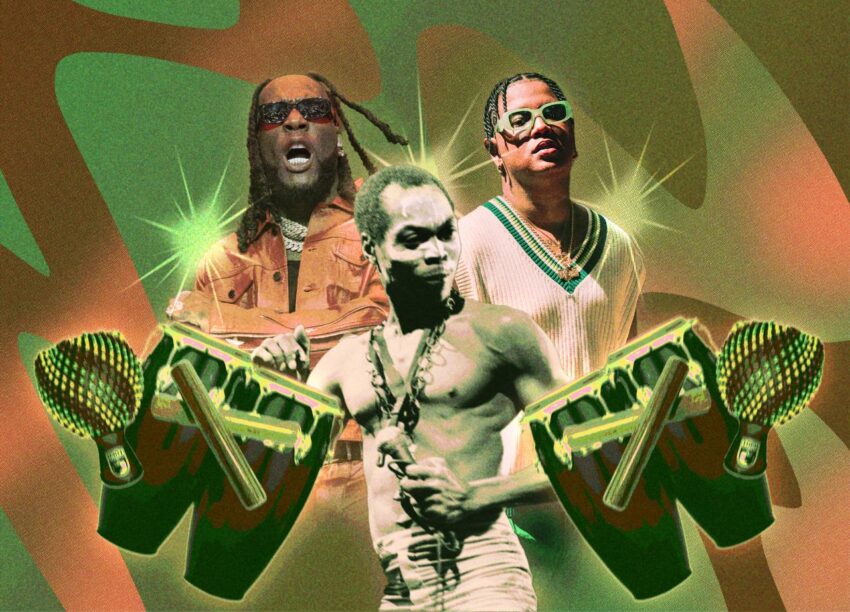
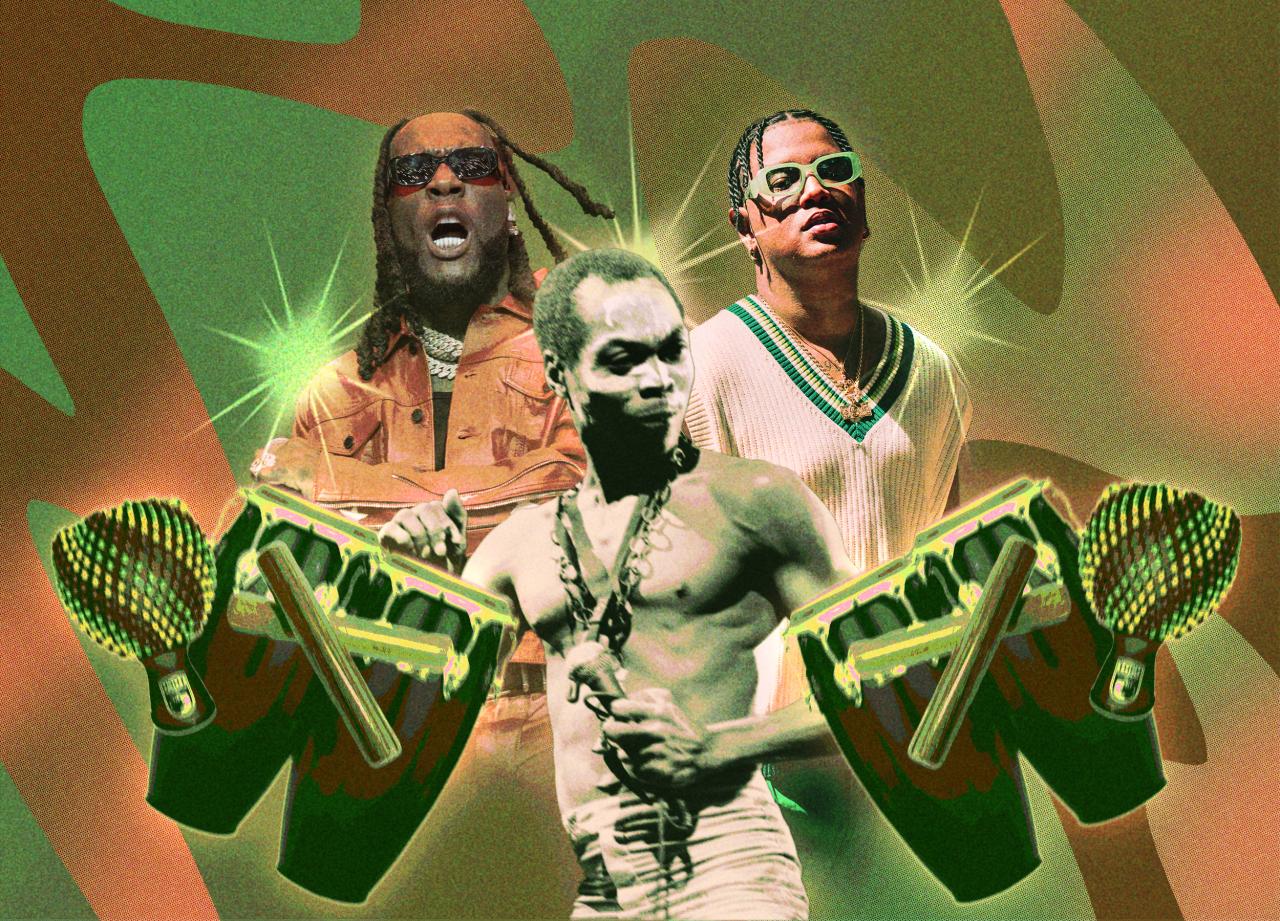
If you have ever searched for African music online, you have probably seen Afrobeat and Afrobeats used as if they mean the same thing.
They do not.
The difference is only one letter, but that small “s” separates two different musical traditions, generations, sounds, and cultural stories.
Afrobeat, usually written without the “s,” refers to the influential sound pioneered and popularized by Nigerian musician Fela Kuti from the late 1960s onward. It brought together West African musical traditions with jazz, funk, percussion, and politically charged songwriting.
Afrobeats, with the “s,” is a much broader contemporary African pop movement that developed decades later. It incorporates influences from highlife, hip-hop, R&B, dancehall, pop, house music, and several African musical traditions. Artists such as Wizkid, Davido, Burna Boy, Tiwa Savage, Rema, Tems, and many others have helped take the sound to audiences around the world.
Understanding this difference makes it easier to appreciate how African music moved from revolutionary live-band performances to one of the biggest sounds in global popular culture.
What Is Afrobeat?
Afrobeat is a specific musical genre associated strongly with Fela Kuti and drummer Tony Allen.
The sound developed around the late 1960s and 1970s, drawing from West African rhythms and traditions while incorporating elements of jazz, funk, highlife, and other international sounds.
Fela did not treat music simply as entertainment.
His songs frequently addressed political corruption, military rule, inequality, colonialism, poverty, and social injustice. His performances could also be extended affairs, with large ensembles, repeated grooves, horns, percussion, improvisation, and extended instrumental passages.
That combination gave Afrobeat a distinctive identity.
It was music designed to make people dance, think, question, and react.
Who Created Afrobeat?
Fela Kuti is widely recognized as the pioneer who developed and popularized Afrobeat.
However, the story was never the work of one musician alone.
His longtime collaborator Tony Allen played an enormous role in shaping the rhythmic foundation of the sound. Fela’s musical development was also influenced by West African traditions and African-American jazz and funk.
That is why Afrobeat is best understood as a musical meeting point between several traditions rather than a sound that appeared from nowhere.
Fela’s influence remains enormous. His work continues to inspire musicians in Nigeria and internationally, and his legacy has become part of the wider history of African popular music.
So What Exactly Is Afrobeats?
Afrobeats is different.
The word generally describes a broad contemporary African pop sound rather than one tightly defined musical formula.
Modern Afrobeats developed through the interaction of Nigerian and Ghanaian popular music with influences including:
-
Highlife
-
Hip-hop
-
R&B
-
Dancehall
-
House music
-
Soca
-
Juju
-
African percussion
-
Electronic production
-
Caribbean sounds
This diversity is one reason it is difficult to describe Afrobeats using a single musical recipe.
Instead of one fixed sound, Afrobeats is constantly changing.
That is why a song by Wizkid can sound very different from one by Rema, while both can still be described as Afrobeats.
Where Did Afrobeats Come From?
Afrobeats developed primarily through the modern West African music scenes of Nigeria and Ghana, particularly during the 2000s and 2010s.
The sound was influenced by earlier African genres, but younger artists and producers began combining those traditions with contemporary global music.
Digital production also changed everything.
Producers could create sophisticated records without requiring the huge live bands associated with classic Afrobeat. Drum machines, synthesizers, samples, digital recording, and later streaming platforms helped artists experiment rapidly.
The result was a more flexible sound designed for radio, clubs, parties, television, social media, and eventually global streaming audiences.
The term “Afrobeats” itself became popular internationally in the early 2010s, particularly in the United Kingdom, where British-Ghanaian DJ Abrantee helped popularize it as a broad label for the emerging West African pop sound.
Afrobeat vs. Afrobeats: The Biggest Differences
The easiest way to understand the difference is to look at their identities.
| Afrobeat | Afrobeats |
|---|---|
| Strongly associated with Fela Kuti | Broad contemporary African pop movement |
| Emerged in the late 1960s and 1970s | Developed mainly from the 2000s onward |
| Strong jazz and funk influence | Strong pop, R&B, hip-hop and dancehall influences |
| Often features large live ensembles | Frequently built around modern digital production |
| Political and social commentary is central to much of the tradition | Themes vary widely, including love, ambition, nightlife and everyday life |
| Often extended compositions | Frequently shorter, streaming-friendly songs |
| Strong connection to Fela’s musical movement | Includes many artists and different sounds |
The important point is that Afrobeats did not simply replace Afrobeat.
They are related, but they remain distinct musical identities.
Why Do People Keep Confusing Them?
The confusion is understandable.
The names look almost identical.
International media also frequently use “Afrobeat” as a general term for African popular music, even when they are actually referring to modern Afrobeats.
Streaming platforms, social media, playlists, and everyday conversations have made the distinction even less consistent.
But for music history, the difference matters.
Calling Fela Kuti’s music “Afrobeats” removes some of the historical specificity of his work.
Likewise, describing modern Nigerian pop as simply “Afrobeat” ignores the many musical influences that helped create contemporary Afrobeats.
How Fela Kuti Influenced Today’s African Music
Even though contemporary Afrobeats is not the same genre as Fela’s Afrobeat, the connection between them is impossible to ignore.
Fela demonstrated that African musicians could create music that was unmistakably African while incorporating international musical ideas.
He also showed that African popular music could carry serious political and cultural messages.
That legacy created a foundation that later generations could reinterpret.
Modern artists do not necessarily sound like Fela, but many operate within a musical culture that his generation helped establish.
His influence can be heard more clearly in some artists than others, particularly musicians who deliberately incorporate Afrobeat-inspired rhythms, live instrumentation, political themes, or samples.
From Highlife to Afrobeats
Afrobeats also cannot be explained through Fela alone.
Highlife, particularly from Ghana and West Africa, played an important role in the development of modern African popular music.
Highlife introduced combinations of African rhythms, guitars, horns, dance music, and popular songwriting that influenced generations of musicians.
As West African musicians moved between countries and musical scenes, sounds began crossing borders.
Nigeria and Ghana became particularly important centers for contemporary African pop.
This musical exchange helped create the environment from which modern Afrobeats eventually emerged.
The Role of Hip-Hop and R&B
Another major change came from the influence of American hip-hop and R&B.
Young African artists were listening to international music while also consuming local sounds.
They began combining rap flows, R&B vocals, African percussion, dancehall rhythms, and local languages.
This created music that could feel both African and global.
Artists were no longer forced to choose between local identity and international influence.
They could have both.
That became one of Afrobeats’ greatest strengths.
The Rise of Nigerian Afrobeats
During the 2000s and 2010s, Nigerian popular music experienced an enormous transformation.
Artists such as 2Baba, D’banj, P-Square, Wande Coal, Olamide, Wizkid, Davido, Tiwa Savage, and Burna Boy helped create different versions of the emerging sound.
There was no single blueprint.
Some artists leaned toward R&B.
Others incorporated dancehall.
Some focused on traditional Nigerian sounds.
Others embraced electronic music, hip-hop, or international pop.
That variety became part of Afrobeats’ identity.
The Global Explosion
The international rise of Afrobeats accelerated dramatically during the 2010s and 2020s.
African artists began performing in major venues outside the continent, collaborating with international stars, and attracting enormous streaming audiences.
Wizkid, Burna Boy, Davido, Rema, Tems and other artists have helped push African music into mainstream global conversations. The Grammy’s own retrospective on Afrobeats describes the genre as having moved from its popularization in the mid-2010s to global chart success.
The growth was not simply about one country.
It also created opportunities for African sounds from Ghana, South Africa, Tanzania, Kenya, Uganda and other countries to reach listeners who previously had limited exposure to them.
Why Afrobeats Keeps Changing
One of the most interesting things about Afrobeats is that it does not stay still.
A popular sound can dominate for a few months before producers introduce something new.
One period may emphasize dancehall.
Another may lean toward Amapiano.
Another may bring stronger electronic influences.
Artists may combine Afrobeats with R&B, hip-hop, house, Fuji, highlife, or traditional rhythms.
This flexibility is part of the reason the genre has remained commercially powerful.
It can evolve without completely losing its African identity.
Is Burna Boy an Afrobeat Artist or an Afrobeats Artist?
This is where the terminology becomes interesting.
Burna Boy is generally associated with Afrobeats and Afrofusion, although his music can incorporate elements associated with older African genres, including Afrobeat.
The same applies to many modern African artists.
Being influenced by Fela Kuti does not automatically make an artist an Afrobeat artist.
A musician can borrow elements from Afrobeat while creating contemporary Afrobeats or another hybrid sound.
That distinction is important because modern African music is increasingly defined by fusion.
Is Afrobeats Only Nigerian?
No.
Nigeria has played a major role in the genre’s international rise, but Afrobeats has never been exclusively Nigerian.
Ghana has also been central to its development and international identity.
Meanwhile, artists across Africa continue to experiment with the sound.
This is why African music should not be reduced to one country’s contribution.
The continent’s music scene is interconnected, and sounds constantly cross borders.
Afrobeats and the African Diaspora
The story also extends beyond Africa.
African communities in the United Kingdom, United States, Europe, and elsewhere have played an important role in spreading African music.
Clubs, DJs, dance communities, radio stations, festivals, social media creators, and diaspora audiences have helped African songs travel.
This created a feedback loop:
African artists → diaspora audiences → international attention → bigger collaborations → new African audiences.
The result is a music culture that is increasingly global while remaining deeply connected to African identity.
Why the Difference Matters
Some people may wonder why one letter deserves so much attention.
It matters because names carry history.
Afrobeat represents a specific musical tradition with a powerful connection to Fela Kuti, Tony Allen, live instrumentation, experimentation, and political expression.
Afrobeats represents a broad contemporary African pop movement built by multiple generations of artists, producers, DJs, and audiences.
Both are important.
Neither needs to replace the other.
Understanding the distinction actually makes African music more interesting because it allows listeners to appreciate how one generation influenced another without pretending they created the same music.
The Future of African Music
The most exciting part of the story is that Afrobeats is still evolving.
Today’s biggest artists are already experimenting with sounds that may eventually create tomorrow’s new genres.
Amapiano has become deeply connected with African pop.
African electronic music continues to grow.
Traditional sounds are being reintroduced through modern production.
Artists are collaborating across countries more frequently.
And streaming has made it easier than ever for listeners to discover music from different parts of Africa.
The next major African genre may already be developing somewhere in Lagos, Accra, Johannesburg, Dar es Salaam, Nairobi, Kampala, Luanda, or another creative city.
Frequently Asked Questions
Is Afrobeat the same as Afrobeats?
No. Afrobeat and Afrobeats are related but distinct. Afrobeat is the genre associated strongly with Fela Kuti and the late-1960s/1970s musical movement, while Afrobeats is a broader contemporary African pop sound.
Who created Afrobeat?
Fela Kuti is widely recognized as the pioneer who developed and popularized Afrobeat, with Tony Allen playing a crucial role in shaping its rhythmic identity.
Who are the biggest Afrobeats artists?
The international Afrobeats scene includes artists such as Wizkid, Burna Boy, Davido, Rema, Tems, Tiwa Savage and many other African musicians.
Did Fela Kuti create Afrobeats?
No. Fela Kuti pioneered Afrobeat, not the contemporary genre commonly called Afrobeats. The modern sound developed decades later through multiple artists, producers, and musical influences.
Is Afrobeats only from Nigeria?
No. Nigeria has been a major force in the genre, but Ghana and other African music scenes have also played important roles in its development and expansion.
Why is Afrobeats so popular globally?
Its combination of infectious rhythms, accessible melodies, African musical influences, modern production, cultural identity, international collaborations, social media, and streaming has helped it reach audiences around the world.
Final Thoughts
The difference between Afrobeat and Afrobeats is more than a spelling issue.
It is a story about generations.
Afrobeat emerged from a period when musicians were using powerful rhythms and fearless songwriting to challenge society. Decades later, Afrobeats developed into a flexible contemporary sound capable of moving between Lagos, Accra, London, New York, Johannesburg and countless other cities.
One is closely associated with Fela Kuti’s revolutionary musical tradition.
The other represents a new generation of African popular music.
Together, they tell a much bigger story: African music has never been static.
It has always borrowed, adapted, experimented, crossed borders, and created something new.
And that may be the most important thing to understand about Afrobeats.
It is not simply one sound.
It is an evolving African musical conversation.
Stay connected with NaijaGrove Entertainment for original African music history, artist stories, genre explainers, album discussions, music reviews, and the latest entertainment news from Nigeria, Tanzania, Ghana, South Africa, and across Africa.